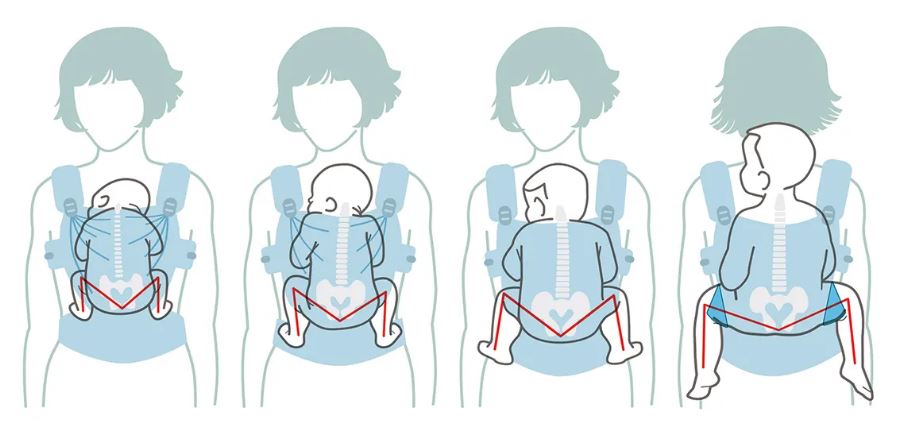
The key to achieving a comfortable and ergonomic position for your baby in a carrier is the “Pelvic Tuck.” This simple technique helps encourage a natural, supported sitting position and can be used with any type of carrier.
While some carriers make it easier to achieve a good fit, even the most expensive ergonomic carrier won’t automatically guarantee proper hip support. Taking a moment to check and adjust your baby’s position is essential to ensure their hips, spine, and overall posture are properly supported.
Your baby only has one set of hips — and they need to support them for a lifetime. Protecting your baby’s hip health is especially important in the early months, as their joints are still developing and maturing.
Some babies are diagnosed early with hip dysplasia and begin treatment with a specialist. However, there are also many cases where hip instability is not identified or formally diagnosed, meaning potential issues may go untreated and could contribute to discomfort or problems later in life.
Hip development concerns can vary in severity. In some babies, the ligaments around the hip joint are looser than usual, allowing the hip to partially slip out of position — known as subluxation, where the ball of the hip joint is no longer perfectly centred in the socket. In more severe cases, the hip may become partially or completely dislocated.
It’s widely understood that babies with a risk of hip dysplasia benefit from being carried in an ergonomic carrier that supports healthy hip positioning, rather than a narrow-based carrier that leaves the legs hanging unsupported. However, it’s also important to remember that not all hip concerns are identified at birth. Some babies are monitored with a “wait and see” approach, while others may have issues that are not detected because they require an ultrasound to confirm — and this is not routinely performed on every baby.
Supporting your baby’s hips with a carrier that encourages a healthy, ergonomic position is one simple way to help promote good hip development during these important early months.
The T.I.C.K.S. rule is an internationally recognised safety guideline for safe and comfortable babywearing. It stands for: Tight, In view at all times, Close enough to kiss, Keep chin off chest, and Supported back.
These five simple checks ensure your baby's airway remains clear and their body is positioned correctly.





Slings and carriers should be tight enough to hug your baby close to you as this will be most comfortable for you both. Any slack/loose fabric will allow your baby to slump down in the carrier which can hinder their breathing and pull on your back.
You should always be able to see your baby’s face by simply glancing down. The fabric of a sling or carrier should not close around them so you have to open it to check on them. In a cradle position your baby should face upwards not be turned in towards your body.
Your baby’s head should be as close to your chin as is comfortable. By tipping your head forward you should be able to kiss your baby on the head or forehead.
a Baby should never be curled so their chin is forced onto their chest as this can restrict their breathing. Ensure there is always a space of at least a finger width under your baby’s chin.
in an upright carry a baby should be held comfortably close to the wearer so their back is supported in its natural position and their tummy and chest are against you. If a sling is too loose they can slump which can partially close their airway. (This can be tested by placing a hand on your baby’s back and pressing gently - they should not uncurl or move closer to you.)
A baby in a cradle carry in a pouch or ring sling should be positioned carefully with their bottom in the deepest part so the sling does not fold them in half pressing their chin to their chest.
No account yet?
Create an Account